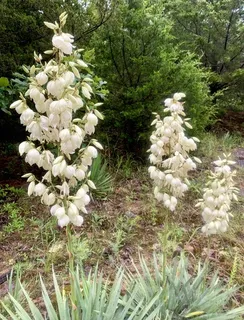
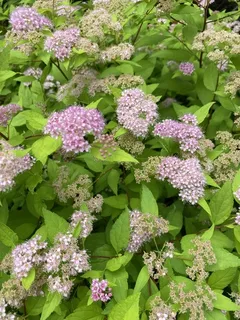
Blue mist spirea
Caryopteris x clandonensis
Blue mist spirea (Caryopteris x clandonensis) is a shrub suited to the Colorado Front Range. It matures to about 2–4 ft tall and 3–4 ft wide, fast-growing, needs low to medium water, and prefers full sun. Bee magnet in late summer. Cut to the ground each spring, treats like a perennial.
On the CSU listlow to medium water2–4 ft tall and 3–4 ft wideXeric / water-wiseZones 2–3 (keep it back from the house)Deer-resistant
Photos
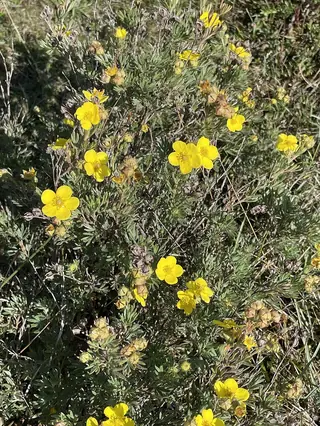
- Photo 1: (c) Wolfgang Jauch, some rights reserved (CC BY)
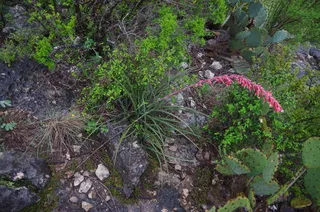
- Photo 2: (c) carnifex, some rights reserved (CC BY), uploaded by carnifex
At a glance
Will it survive here?
- Hardiness zones
- USDA 5–9
- Water needs
- low to medium water
- Sun
- Best in full sun.
- Soil
- loam, well drained only
- Soil pH
- 6.5–8.0
- Hail tolerance
- moderate
- Wind tolerance
- moderate
- Salt tolerance
- moderate
- Firewise (defensible space)
- Zones 2–3 (keep it back from the house)
How big, what shape?
- Mature size
- 2–4 ft tall and 3–4 ft wide
- Planting spacing
- ~4 ft apart (3 ft for a hedge/screen)
- Growth rate
- Fast
What it looks like, and when
- Bloom time
- late summer, early fall
- Bloom color
- blue, purple
- Bloom length
- Long (several weeks)
- Foliage
- Deciduous
Who else benefits
- Pollinator value
- high
- Deer
- Generally deer-resistant
- Colorado native
- No
Things to know before you plant
- Spreads aggressivelySelf-seeds heavily in CO gardens; volunteers pop up in nearby beds
Common problems on the Front Range
No major pest or disease problems are commonly reported for this plant on the Front Range. Keep it well sited and watered, and watch for the usual stress-driven issues in drought or heat.
Planting & establishment
Water deeply 1×/week through first summer. Cut back hard to 6 inches in early spring, it blooms on new wood.
- Pruning: hard (rejuvenation).
Frequently asked questions
- Is Blue mist spirea good for the Colorado Front Range?
- Yes, Blue mist spirea is a well-suited shrub for Colorado's Front Range.
- What should I know before planting Blue mist spirea?
- The main things to know: Self-seeds heavily in CO gardens; volunteers pop up in nearby beds
- How big does Blue mist spirea get?
- It matures to about 2–4 ft tall and 3–4 ft wide.
- How far apart do I plant Blue mist spirea?
- Space Blue mist spirea about 4 ft apart for a full, natural form, or about 3 ft apart for a faster hedge or screen.
- Is Blue mist spirea hardy on the Front Range?
- Blue mist spirea is hardy in USDA 5–9. The Colorado Front Range spans roughly USDA 4b–6a, so it is at its cold edge here. Site it in a warm microclimate and protect young plants.
- How much water does Blue mist spirea need?
- It needs low to medium water once established.
- How fast does Blue mist spirea grow?
- Blue mist spirea is a fast-growing shrub. Growth rate depends on water and site conditions on the Front Range.
- Is Blue mist spirea native to Colorado?
- No. It is not a Colorado native, but it grows well on the Front Range.
- Is Blue mist spirea deer-resistant?
- Blue mist spirea is generally considered deer-resistant, though no plant is deer-proof when browse pressure is high.
- Is Blue mist spirea a good firewise plant near the house?
- Blue mist spirea is suitable in defensible-space zones 2–3, best kept back from the house rather than in the area right against the structure. This is general suitability guidance based on CSU Extension firewise plant lists, not a guarantee that any plant won't burn, a well-irrigated, well-maintained plant is the goal. Follow CSU Extension defensible-space guidance and check with your local fire district before planting in the wildland-urban interface.
- Is Blue mist spirea prone to pests or disease on the Front Range?
- Blue mist spirea has no major pest or disease problems commonly reported on the Front Range. Keep it well sited and watered, and watch for stress-driven issues in drought or heat.
- How long does Blue mist spirea bloom?
- Blue mist spirea blooms for several weeks, a long-season performer on the Front Range. Bloom timing shifts a week or two with elevation and spring weather.