Bindweed in Colorado: why you can't kill it, and what actually works
Quick answer
You cannot kill established bindweed in one season, and anyone selling a one-shot cure is wrong. Its roots run 20 feet deep and its seeds last up to 40 years in the soil. What works is relentless depletion: cut off every bit of top growth on a tight schedule, or paint a systemic herbicide on it in fall, then crowd the ground with dense planting. Plan on two to five years.
Field bindweed is the weed Front Range gardeners complain about most, and for good reason: it is built to outlast you. There is no one-and-done fix, but there is a plan that works. Here is what Colorado State research and Denver gardeners agree on, method by method, plus how long each one really takes.
What you're actually fighting
Field bindweed (Convolvulus arvensis) is a non-native perennial in the morning glory family. Colorado State research puts the roots at 20 feet deep or more, creeping horizontally as they go, and the state Department of Agriculture says the seeds can sit dormant in your soil for up to 40 years and still sprout. When one r/DenverGardener member (u/merft) replaced a driveway, they found bindweed roots "extending over 20-feet under the concrete."
That is why it feels personal. You are not fighting the vine you see. You are fighting a root system the size of your yard and a seed bank that was there before you were. Two things follow, and they explain almost every frustration people have:
- It regrows from root fragments. Chop a root into ten pieces with a tiller or a shovel and you can get ten new plants.
- Pulling the top does not reach the roots, so established plants generally survive it. Some Denver gardeners go further and say casual pulling can even spur it on.
The research and the local consensus point the same way: bindweed dominates disturbed ground and is far weaker against a thick stand of competing plants. That is the whole long-term strategy in one sentence, and we come back to it at the end.
Is bindweed the same as morning glory?
Sort of, and this trips people up. Bindweed is in the morning glory family: small white-to-pink trumpet flowers about an inch across, arrowhead leaves, and low twining stems to six feet (per the state species page). And it comes back every year no matter what you do. The ornamental morning glory people plant on purpose (Ipomoea) is a different plant: an annual with much bigger showy flowers that dies at frost and does not return from a deep perennial root. So if it comes back every spring on its own, it is bindweed, not your morning glory.
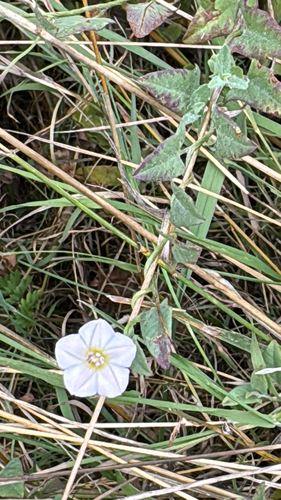 Field bindweed: a small white funnel flower, arrowhead leaves, low twining stems.
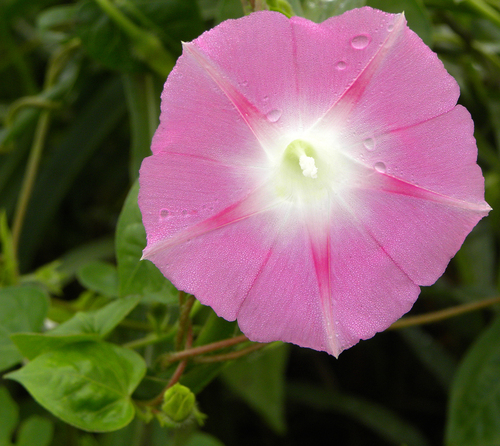 Ornamental morning glory: a much bigger showy flower, heart-shaped leaves, dies at frost.
Coloradans also sometimes confuse it with wild buckwheat (occasionally called black bindweed), which climbs aggressively but is an annual with shallow roots and pulls up easily. If it comes out without a fight, it probably is not field bindweed.
Why the usual fixes disappoint
| What people try | What actually happens |
|---|---|
| Pulling it all out | Established plants regrow from the roots. Pulling only helps as a relentless routine that slowly starves the roots (CSU: remove top growth before root buds form), not as a weekend cleanup. |
| Covering it with fabric or cardboard | It travels sideways under the barrier and pops up at the edges. Colorado gardeners report it threading out from under mulch, fabric, even concrete (eOrganic). |
| Tilling it under | Worst move. Every chopped root fragment can become a new plant, so tilling multiplies it (eOrganic). |
| Vinegar, salt, or dish-soap sprays | Vinegar burns the top but the roots shrug it off. Salt is actively harmful: it wrecks soil biology and can poison the spot for future plants. The top-voted answer in one Colorado thread is a plea to never use salt. |
| One herbicide spray | Kills what is up today. The seed bank refills it for years, so you are signing up for repeat treatment, not a cure (CSU). |
Every option, side by side
What Colorado State research says, what Denver-area gardeners report, and the realistic timeline, laid out together. The catch: no single method ends the fight by itself. The winning play is a combination, knock it back, then keep the ground covered so it cannot recolonize.
| Method | What CSU / CDA says | What Denver gardeners report | Realistic timeline |
|---|---|---|---|
| Relentless pulling / cutting | Removing top growth before it stores energy gradually depletes the roots; hand-pulling alone rarely kills established plants (PlantTalk 2104). | Pulling every 8 to 9 days all season is the version that works. One gardener reports about 90% knockdown after two years; another, seven years in, calls it never done. | 2+ years, ongoing |
| Paint or sponge a systemic herbicide | Systemic post-emergents work best in late summer to fall when the plant moves sugars to the roots; sponge or paint it on to spare nearby plants, per the label (PlantTalk 2104). | Locals: wipe it on, hit it in fall, expect to repeat because the seed bank refills. | Multiple seasons |
| Quinclorac (lawns only) | Highly effective on bindweed in turf; labeled for lawns ONLY, never beds or vegetable gardens (PlantTalk 1552). | Less discussed by name; the lawn crowd leans on three-way broadleaf products. | A season or more |
| Bindweed gall mites | Aceria malherbae cause galling and stunting that weaken bindweed over 1+ years; work best on dry, unsprayed ground, little effect in watered lawns (PlantTalk 1493). | The recurring community answer, with a reality check: waitlist, and they are for dry problem areas, not your lawn. | Up to 3 years for full effect |
| Crowd it out (dense planting) | Bindweed needs light and open ground; a dense healthy planting suppresses it. Competition manages it, it does not eradicate it (PlantTalk 1552; eOrganic). | Experienced posters replace knocked-back bindweed with dense natives like Colorado four o'clock and winecup. | Ongoing, after knockdown |
The Colorado-only option most guides skip: gall mites
If you have a big, dry, unsprayed patch of bindweed (a vacant lot, a hell strip, an un-irrigated back corner), Colorado has a tool most states do not. The Department of Agriculture's Palisade Insectary raises bindweed gall mites (Aceria malherbae) and ships them to Colorado landowners through its Request-A-Bug program. The details, from the state's own page:
- Colorado landowners and managers only, and it is fee-based. Field bindweed mites are $35 per release, distributed June through August.
- You join a waitlist; requests are filled in the order received and carry over year to year, so order early.
- The mites establish within a year and overwinter here, but full effect typically takes up to three years.
- They do not work everywhere. Excess moisture stops them from establishing, so they are useless in a sprinkler-irrigated lawn. Dry, neglected infestations are where they work.
Set expectations: the mites suppress bindweed, they do not erase it. Denver gardeners who use them treat them as one slow lever among several, often bridging the wait with hand-pulling or a spray on the top growth.
A realistic plan
If you want one sequence to follow, this is it.
- Decide the zone. Lawn, garden bed, or dry neglected patch? The right tool differs for each (see the table). Do not use lawn herbicides in beds.
- Stop the seeds first. Never let it flower and set seed. Every seed you prevent is up to 40 years you save later.
- Knock back the top growth on a schedule. In beds, pull or cut every 8 to 9 days through the season. Do not till, it multiplies from fragments.
- Hit the roots in fall. For a serious infestation, sponge or paint a systemic herbicide in late summer to fall, when the plant is moving sugars down, per the label. Repeat next year; the seed bank will resupply.
- For big dry patches, get on the mite waitlist now. Request-A-Bug fills in order received, so earlier is better.
- Close the ground behind you. As you clear space, plant it densely so bindweed has no open, sunny ground to reclaim. This is maintenance, not a finish line.
When to do what through the season
| Time of year | Move |
|---|---|
| Early spring (Mar-Apr) | First flush emerges. Start pulling early to starve the roots before they reload; Denver gardeners run the routine every 8 to 9 days. |
| Late spring to summer (May-Aug) | Peak growth and flowering. Keep pulling; never let it flower or seed. June to August is also the window to release gall mites on dry sites. |
| Late summer to fall | The best herbicide window: the plant translocates to its roots, so a painted systemic herbicide reaches deepest. |
| Anytime you clear a patch | Replant densely so you are not handing it bare ground. |
Crowd it out: dense planting for the ground you clear
This is the payoff of the disturbance-plant idea from up top: keep the ground occupied and bindweed has far less room to work. Dense planting will not erase what is already in your soil, but it is the difference between an annual war and a manageable one. As you clear a patch, close the ground behind you with tough, low-water Front Range plants that fill in fast, starting with the two natives Denver gardeners name for exactly this job.
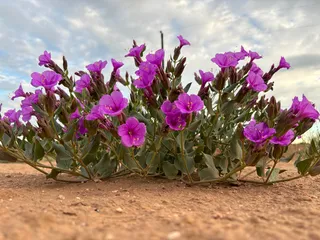 Desert Four O’Clock Mirabilis multifloraA tough native that Denver gardeners plant to fill space after knocking bindweed back. Low-water, sprawling, and happy in lean Front Range soil.
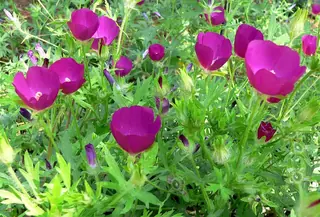 Poppy Mallow Callirhoe involucrataWinecup, the other native locals name for this job. It runs along the ground on low-water sites and knits in fast to leave less open dirt.
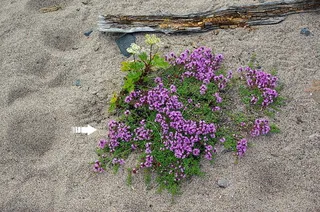 Creeping thyme / wild thyme Thymus serpyllumA dense, low-water mat that carpets sunny ground and takes light foot traffic. Good for closing the gaps between larger plants.
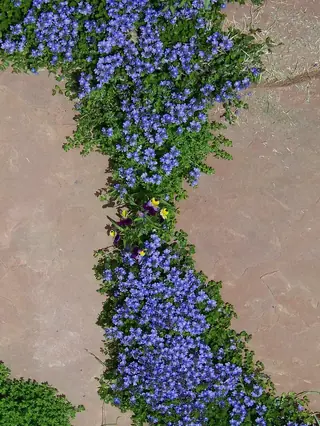 Turkish veronica Veronica liwanensisA fast, tight, low-water mat with spring bloom. Spreads to cover exposed soil in sun without asking for much water.
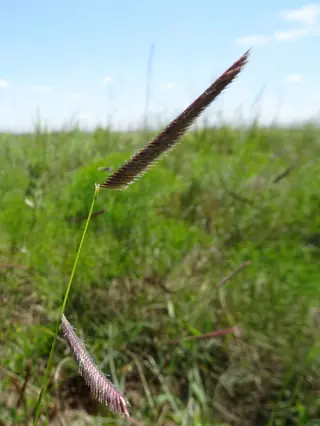 Blue grama grass Bouteloua gracilisA native short grass for a low-water lawn alternative. A thick stand shades out the open ground bindweed needs.
Frequently asked questions
- Does vinegar kill bindweed?
- It burns the leaves and stems you spray, which can slow it down, but it does not reach the roots that run 20 feet deep, so the plant comes back. Some Denver gardeners use a vinegar and soap spray as a stopgap while they wait on a longer-term fix like mites.
- Will landscape fabric or cardboard stop bindweed?
- Not reliably. Bindweed travels sideways under barriers and surfaces at the edges or through seams. Coloradans report it emerging from under mulch, fabric, and even concrete. Use cover as one layer of a plan, not the plan.
- Should I use salt to kill it?
- No. Salt can kill the top but it damages soil biology, compacts the soil, and can leave the spot unable to grow anything for a long time. Experienced Colorado gardeners specifically warn against it.
- Is bindweed the same as morning glory?
- It is a wild perennial cousin. Ornamental morning glory (Ipomoea) is a big-flowered annual that dies at frost. Bindweed has smaller white-to-pink flowers, arrowhead leaves, and a perennial root system that returns every year.
- Do I legally have to remove bindweed in Colorado?
- Field bindweed is on Colorado's noxious weed List C. In the state's framing, these species are widespread and well established, so statewide eradication is impractical, and the Department of Agriculture provides education, research, and biological control to support local management. In plain terms: the state does not require you to control it, though some counties or cities may have their own rules, so check locally.
- How long does it really take to get rid of bindweed?
- Plan on years, not weeks. Denver gardeners report roughly 90% control after two seasons of disciplined effort, and describe it as manageable but never fully gone even after seven years. Anyone promising a one-season cure is overselling.
From the community
Bindweed is one of the most-piled-on topics in the Front Range gardening subreddits, and the line that comes up in nearly every thread is blunt: you do not get rid of it, you learn to manage it. A few voices from locals who have been in the fight, with credit and links to their comments:
- u/SarahLiora on r/DenverGardener: the routine that works is pulling every 8 to 9 days all season to starve the roots, and she reports about 90% control after two years. Read the comment.
- u/oleblueeyes75 on r/DenverGardener: seven years into the same yard and no chemicals, the battle "is never ending but it's a whole lot better." Read the comment.
- u/a-thinking-thing on r/DenverGardener: on painting herbicide onto the vine: "While I hate herbicides, there is a time and place for everything." Read the comment.
- u/atreeindisguise on r/NativePlantGardening: the top-voted plea in the thread: do not use salt, it kills the soil life and compacts the ground for whatever you plant next. Read the comment.
Get the Front Range planting guide
A free monthly email: what to plant, what to avoid, and when, for our clay, hail, and dry winters. No spam, unsubscribe anytime.
Sources
The bindweed biology, control, legal status, and gall-mite guidance on this page come from:
- CSU PlantTalk Colorado, Controlling Bindweed (2104)
- CSU PlantTalk Colorado, Bindweed Control in Lawns (1552)
- CSU PlantTalk Colorado, Bindweed Mites (1493)
- Colorado Department of Agriculture, Field Bindweed (species ID)
- Colorado Department of Agriculture, Colorado Noxious Weed List
- Colorado Department of Agriculture, Palisade Insectary Request-A-Bug
- eOrganic, Field Bindweed: Why It's So Hard to Manage
What this page is not: it gives no herbicide rates or mixing instructions beyond "systemic, painted on, per the label," claims no plant eradicates bindweed (competition suppresses, it does not cure), and does not say the state forces you to remove it (List C is education and support; local rules vary).